Five Simple Measures To Defend Against H1N1
As a global pandemic, H1N1 is rearing its head and spreading itself far and wide. There is no excuse for not knowing anything about it nor not taking any precautionary steps to prevent against it. We’ve outline 5 simples steps for you to take and protect yourselves and your loved ones against H1N1.
1) Washing your hands with soap
Your hands are usually in direct contact with surfaces and are exposed constantly to all types of germs, those of which can cause serious infections. Therefore, your hands can pose a danger to yourself and others and should be washed thoroughly and regularly with soap:
- Before and after meals
- Before handling food
- After using the toilet
- After blowing your nose
- After touching contaminated surfaces like tabletops, doorknobs, handrails, etc
Proper handwashing requires soap and water. By rubbing, soap breaks down the grease and dirt that carry most germs. Washing your hands for 30 seconds with soap and water does not just make your hands smell fresh but also reduces germs counts by up to 99.9%.
Follow diagram below for the correct method of washing your hands:-
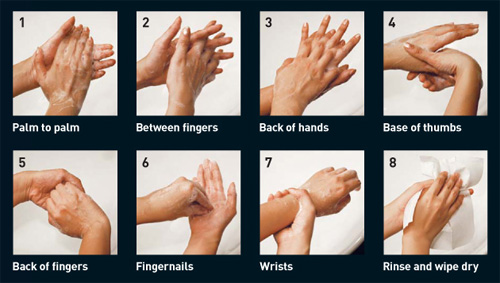
Correct Method Of Washing Hands
In the event when there is no soap and/or water for your sanitary purpose, it is recommended that you use Dettol RC-104808 Instant Hand Sanitizer for your hand-washing purposes. The Dettol RC-104808 Instant Hand Sanitizer is able to kill 99.99% of germs without water and it’s rinse free and non-sticky. It comes with compact travelling size which is very suitable for your travelling use.
Alternatively, you can also use Angel Wet Wipes for normal wiping purposes. Use it before and after meals and maybe the table and/or chairs to ensure your environment is clean and hygiene. Angel Wet Wipes are comparatively cheaper than other wipes and it is unscented, therefore does not contain any harmful or irritating artificial addictives. It’s anti-bacterial formula provides the hygienic care for you during your travel or dine-out.
2) Covering your mouth and nose with tissue
When you cough or sneeze, the germs in the secretions can spread and infect others. Also, these germs can contaminate surfaces like tabletops, doorknobs, or handrails from which they are picked up by others who touch these surfaces. So when you cough or sneeze, remember to cover your mouth and nose with a tissue. Dispose your used tissue paper in the dustbin properly.
3) Wearing a surgical mask if unwell
If you have the flu, put on a surgical mask to protect others. Follow these simple steps to wear a mask:
- Check for a thin metallic strip along the edge of the mask to ensure you have the right side up. The folds of the mask should point downwards and face out.
- Loop the bands over your ears or tie it securely behind your head, if it requires tying.
- Press your nose bridge to check that you have a close fit.
- Check all areas around the mask to make sure there are no gaps. The mask should cover your mouth, your nose and your chin.
- Tighten the bands or adjust the mask if required.

How To Put On Mask
Remember to wash your hands before putting on your mask and after disposing it in the dustbin. Change your mask every eight hours or when it becomes moist.
4) Taking your temperature correctly
A fever can be one of the first signs of an infection. A reading of 38 degrees Celsius or more could be an indication of a serious infection such as Influenza. Take your temperature if you feel unwell and see your doctor if you have a fever. Follow these simple steps to take your temperature correctly:
- When using a digital thermometer in the mouth:
- Wash the thermometer with soap and water before and after every use.
- Switch the thermometer on and place the tip under the tongue.
- Hold in place for about one minute until you hear a beep that signals the measurement has been taken.
- Read the temperature.
- When using an ear thermometer:
- Put a disposable cap on the thermometer.
- Switch the thermometer on and wait for the digital display to appear.
- Gently pull the ear backwards and upwards to straighten the ear canal.
- Gently insert the thermometer’s earpiece into the ear and press the activation button.
- Hold in place until you hear a beep to signal that the measurement has been taken.
- Remove the thermometer and read the temperature.
- Discard the disposable cap.
If you have a fever and develop flu symptoms (e.g. sore throat, runny nose, cough, muscle aches and tiredness), put on a mask and make your way to see a doctor. Stay home until you have recovered fully.
5) Leading a healthy lifestyle
Keep yourself and others safe by observing good personal hygiene habits and by being socially responsible (e.g. never spit in public places, using a serving spoon when sharing food from a common plate). Leading a healthy lifestyle helps to build up your immunity and protects you against infection. It is important that you:
- Eat a balanced diet, including plenty of fruits and vegetables.
- Do 30 minutes of physical activity at least 5 days a week.
- Learn to relax and have enough sleep and rest
- Do not smoke
Just remember, you can never be too careful when comes to Influenza A (H1N1).

Best Protection Against Influzenza
For a lighter side of this measures, and in case you forget to wash your hand, I think this video will help you to remember it better, in fact, I’m having trouble forgetting it now:-
For more information on Influenza A (H1N1), please visit the following website:
Recommended Products:-
.

Related posts:
- What is Influenza A (H1N1-2009)?
- Vaccination And Protection Against Influenza A (H1N1-2009)
- The Purpose of Baby Wet Wipes
- H1N1 Flu Vaccine May Be Coming Nearer To Us Soon
- H1N1 Swine Flu Vaccination Profile Email Embeds Computer Viruses
 Author's Bio:
ShopBug.com is a Singapore registered online webstore that sells baby products and ladies fashion. We are a commercial entity but we write posts that remain as neutral as possible, and in the event when we recommend products from our webstore, we'll try to list them separately to keep you aware. We will not be bias in our story just to sell you any products and all posts written by us are as genuine as it can be.